
Data lineage in Anjana Data enables understanding the data lifecycle from different perspectives — business, technical, data consumption audit, among others. Its correct configuration is essential to guarantee traceability, control and understanding of how data is generated, transformed, used and consumed within the organisation.
Anjana Data offers the ability to configure lineage layers, in which the different types of entities and relationships are pre-filtered, allowing the visualisation to focus on the most relevant elements for each use case.
In each layer, relationships can be configured as aggregating or containing. This means it is possible to define that certain types of objects, when related through a specific type of relationship, are displayed as contained within a parent object, thus facilitating a hierarchical and simplified view.
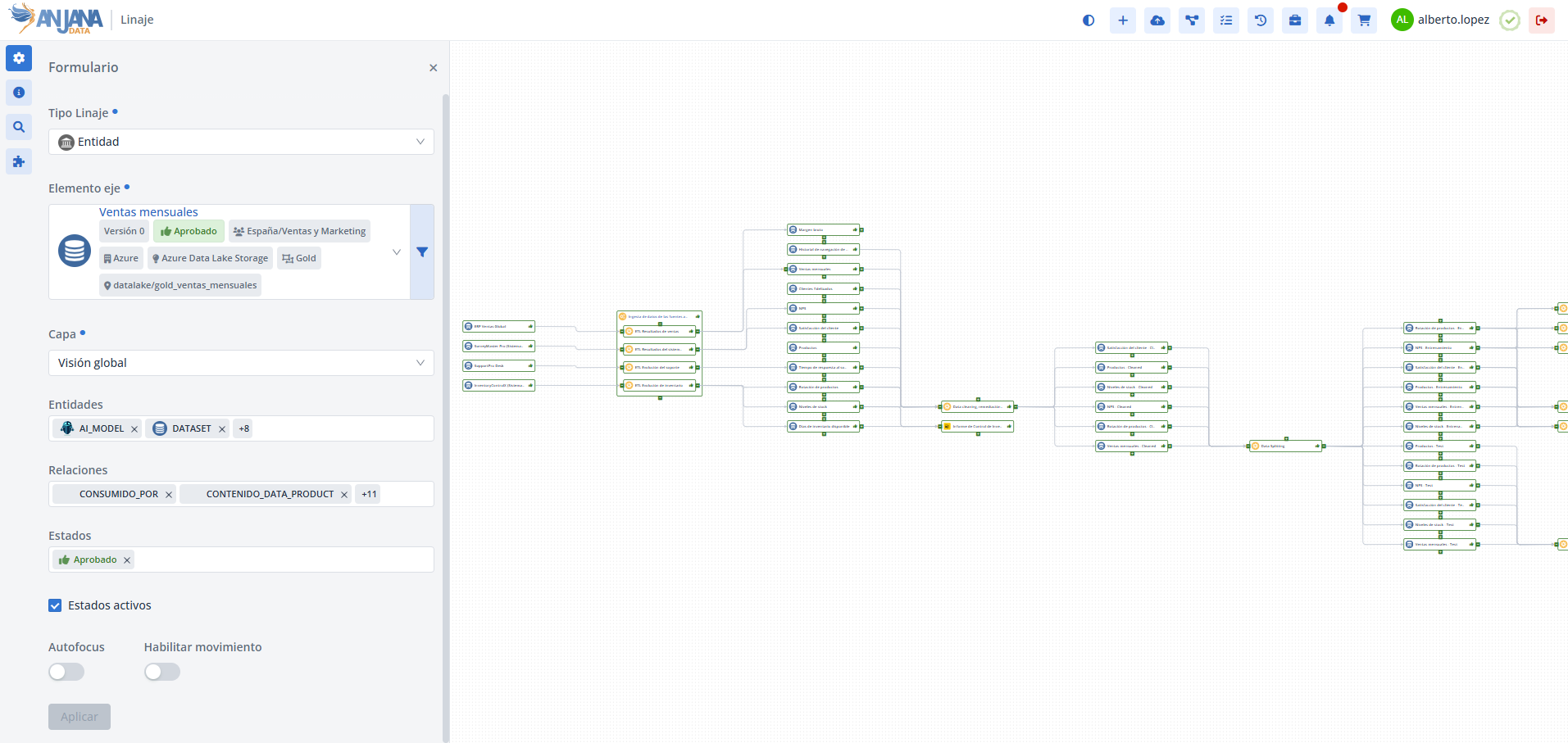
Main elements of lineage configuration
-
Lineage layers: definition of the different data lifecycle visualisation levels, filtering entities and relationships according to the perspective (business, technical, audit, etc.).
-
Entity and relationship pre-filters: selection of which types of entities and relationships are visible in each layer, adapting the information shown to the user according to their role or need.
-
Aggregating/containing relationships: display certain objects as an integral part of others, providing a structured and simplified view.
Goal
The goal of this configuration is to provide the organisation with understandable, flexible data lineage adapted to different levels of analysis, ensuring that each user profile can access the information needed to understand the origin, use and transformation of data in a clear and effective manner.