
In Anjana Data Platform, the search engine is a key component for the efficient exploitation of metadata and management of data assets. Its configuration must be designed to maximize the relevance of results, taking into account the object subtypes and the metadata attributes most significant to the business.
This guide explains how to modify the behavior of the Anjana Data Platform search engine through SOLR configuration. This makes it possible to adjust the relevance of object subtypes and their metadata, apply stopword filters, and define custom search field types to optimize search results.
Prerequisites
-
Access to the SOLR core configuration API (
kerno) in your Anjana Data environment. -
Basic knowledge of
curlcommands and JSON format. -
The commands assume that the kerno collection is being used.
-
For
curlcommands, the-koption is used for insecure connections (ignoring the SSL certificate), which may be necessary in test environments or with self-signed certificates.
Below is the complete procedure for configuring the weightings, which is recommended to be run from start to finish.
If reusing the commands included in this guide, <url_entorno> must be replaced with the corresponding value.
If, after completing all the steps, the portal does not load correctly, it is recommended to remove the search engine configurations.
1. Main Search Handler Configuration (/select)
This step defines how search results are sorted and prioritized in Anjana Data Platform.
Through the configuration of the /select handler, the following is established:
-
Which asset types should appear first.
-
Which asset attributes weigh more when calculating relevance.
This way, the search engine adapts to the actual use of the business, prioritizing the assets that provide the most value to the end user.
Example command
In the following example, result priorities are defined based on:
-
Object subtype (OBJ_SUB_TYPE)
-
DATASET_FIELD: penalized with a weight of-10so that dataset fields appear at the end of the results. -
DATASET: weight18 -
DSA: weight17 -
PROCESS: weight16 -
INSTANCE: weight15 -
SOLUTION: weight14
This means, for example, that a complete dataset appears before its individual fields when the user performs a search.
-
-
Key metadata attributes
-
OBJ_NAME: assigned a weight of25, meaning that the logical name of the asset is one of the most important factors in deciding which result is shown first.
-
curl -k -X POST --header 'Content-type: application/json' -d '{
  "update-requesthandler": {
    "name": "/select",
    "class": "solr.SearchHandler",
    "defaults": {
      "echoParams": "explicit",
      "rows": "10",
      "defType": "edismax",
      "qf": "OBJ_SUB_TYPE^25 OBJ_NAME^25 _text_^0.5",
      "bf": "if(termfreq(OBJ_SUB_TYPE,\"DATASET_FIELD\"),-10,if(termfreq(OBJ_SUB_TYPE,\"DATASET\"),18,if(termfreq(OBJ_SUB_TYPE,\"DSA\"),17,if(termfreq(OBJ_SUB_TYPE,\"PROCESS\"),16,if(termfreq(OBJ_SUB_TYPE,\"INSTANCE\"),15,if(termfreq(OBJ_SUB_TYPE,\"SOLUTION\"),14,1))))))"
    }
  }
}' https://solr1server.<url_entorno>:8983/solr/kerno/config
High-Level Explanation:
This command updates the search engine configuration to:
-
Prioritize the information most relevant to the business
It specifies that certain asset types (for example, DATASET or DSA) should appear above others (such as DATASET_FIELD). This helps the user see the most significant assets first and avoid getting lost in overly detailed results. -
Give more weight to key search fields
Special emphasis is placed on the object subtype (OBJ_SUB_TYPE) and the logical name of the asset (OBJ_NAME), so that:-
If the search term appears in the asset's name, that result moves up in ranking.
-
If the term relates to an asset type that the business considers more relevant (for example, a DATASET versus a field), this is also reflected in the order of the results.
-
In summary, this step allows the client to align the search engine's result ranking with their business priorities, without needing to change the platform's functional logic.
2. Configuration of Stopword Lists
Stopwords are common words that are excluded from the search because they add no value in identifying an asset.
They are terms that appear very frequently in natural language but, by themselves, do not help differentiate or locate relevant information.
Typical examples would be:
-
In Spanish: de, la, los, un, para, con, sobre, este, esa…
-
In English: the, a, at, on, of, by, this…
If these words were kept within the search analysis:
-
They would stand out over genuinely relevant terms.
-
They would reduce the precision of the results.
-
They would make the search engine slower or less efficient.
For this reason, Solr allows defining stopword lists that filter out these words before the indexing and query process, preventing them from influencing the relevance of the results.
2.1. Creating the Stopword Resources
These commands create the managed stopword resources for Spanish and English in the SOLR schema.
Example Commands (Creation):
curl -k -X PUT -H 'Content-type:application/json' --data-binary '{"class":"org.apache.solr.rest.schema.analysis.ManagedWordSetResource"}' "https://solr1server.<url_entorno>:8983/solr/kerno/schema/analysis/stopwords/spanish"
curl -k -X PUT -H 'Content-type:application/json' --data-binary '{"class":"org.apache.solr.rest.schema.analysis.ManagedWordSetResource"}' "https://solr1server.<url_entorno>:8983/solr/kerno/schema/analysis/stopwords/english"
High-Level Explanation:
Two managed word set resources (ManagedWordSetResource) are created in the SOLR schema, one called spanish and another english. This allows managing stopword lists through the API instead of static files.
2.2. Inserting Stopwords in Spanish and English
This command inserts the list of stopwords specific to the Spanish language.
Example Command (Spanish):
curl -k -X PUT -H 'Content-type:application/json' --data-binary '["últimos","último","últimas","última","éstos","éste","éstas","ésta","éramos","él","yo","ya","y","vuestros","vuestro","vuestras","vuestra","voy","vosotros","vosotras","vez","VERDADERO","verdadera","verdad","ver","veces","vaya","varios","varias","van","vamos","valor","vais","va","usted","uso","usas","usar","usan","usamos","usais","usa","unos","uno","unas","una","un","ultimo","tú","tuyos","tuyo","tuyas","tuya","tuvo","tuviésemos","tuviéramos","tuvisteis","tuviste","tuvimos","tuvieses","tuviesen","tuvieseis","tuviese","tuvieron","tuvieras","tuvieran","tuvierais","tuviera","tuve","tus","tu","tres","través","trata","tras","trabajo","trabajas","trabajar","trabajan","trabajamos","trabajais","trabaja","total","todos","todo","todavía","todas","toda","tienes","tienen","tiene","tiempo","ti","tercera","tenías","tenían","teníamos","teníais","tenía","tenéis","teniendo","tenidos","tenido","tenidas","tenida","tengáis","tengo","tengas","tengan","tengamos","tenga","tener","tenemos","teneis","tened","tendrías","tendrían","tendríamos","tendríais","tendría","tendréis","tendré","tendrás","tendrán","tendrá","tendremos","te","tanto","tan","tampoco","también","tal","sólo","sí","suyos","suyo","suyas","suya","sus","su","soy","son","somos","solos","solo","solas","solamente","sola","sois","sobre","sino","sin","siguiente","sigue","siete","ya","y","vez","ver","veces","varios","varias","usted","tuvo","tres","través","trata","total","todos","todavía","todas","toda","tercera","tenido","tenga","tendrán","tendrá","tenía","tanto","tan","tampoco","tal","son","solos","solas","sola","sino","siguiente","sigue","siete","siempre","sido","sería","serán","será","seis","segundo","segunda","según","sean","sea","señaló","se","sólo","sí","respecto","realizar","realizado","realizó","quiere","quienes","quién","queremos","quedó","que","qué","pues","pueda","pudo","propios","propio","propias","propia","principalmente","primeros","primera","primer","próximos","próximo","posible","poner","podrían","podría","podrán","podrá","pocos","poco","pocas","poca","pesar","pasado","pasada","partir","parte","parece","otros","otras","otra","ocho","o","nunca","nuevos","nuevo","nuevas","nueva","nuestros","nuestro","nuestras","nuestra","nosotras","no","ningunos","ninguno","ningunas","ninguna","ningún","ni","nadie","nada","mucho","muchas","mucha","momento","mismos","mismo","mismas","misma","mi","menos","mencionó","mejor","mediante","me","mayor","manifestó","manera","más","lugar","luego","llevar","lleva","llegó","les","le","lado","junto","informó","indicó","igual","hubo","hoy","hizo","hicieron","hemos","hecho","he","haya","hay","hasta","han","haciendo","hacia","hacerlo","habrá","haber","habían","había","grandes","gran","fuera","expresó","explicó","existen","existe","ex","estuvo","estos","esto","este","estas","estará","estar","estaban","están","está","esos","eso","ese","esas","esa","encuentra","embargo","ello","ella","ejemplo","e","durante","dio","dijo","dijeron","diferentes","diferente","dieron","dicho","dicen","dice","después","demás","del","dejó","decir","debido","deben","debe","de","dar","dan","dado","da","cuenta","cuatro","cuanto","cualquier","cuales","creo","cosas","contra","considera","consideró","conocer","comentó","cinco","cerca","casi","cómo","buenos","bueno","buenas","buena","buen","ayer","aunque","aseguró","así","aquí","aproximadamente","apenas","anterior","alrededor","algo","al","ahora","ahí","agregó","afirmó","además","adelante","actualmente","aún","añadió","a","últimos","último","últimas","última","éstos","éste","éstas","ésta","él","yo","voy","vosotros","vosotras","VERDADERO","verdadera","verdad","vaya","van","vamos","valor","vais","va","uso","usas","usar","usan","usamos","usais","usa","unos","uno","unas","una","un","ultimo","tuyo","tras","trabajo","trabajas","trabajar","trabajan","trabajamos","trabajais","trabaja","todo","tienen","tiene","tiempo","tengo","tener","tenemos","teneis","también","sus","su","soy","somos","solo","solamente","sois","sobre","sin","siendo","si","ser","sabes","saber","saben","sabemos","sabeis","sabe","quien","puedo","pueden","puede","primero","porque","por qué","por","podrias","podrian","podriamos","podriais","podria","poder","podemos","podeis","pero","para","otro","nosotros","nos","muy","muchos","modo","mio","mientras","los","lo","las","largo","la","ir","intento","intentas","intentar","intentan","intentamos","intentais","intenta","incluso","hago","haces","hacer","hacen","hacemos","haceis","hace","ha","gueno","fuimos","fui","fueron","fue","fin","estoy","estan","estamos","estais","estado","estaba","esta","es","eres","eras","eran","eramos","era","entre","entonces","encima","en","empleo","empleas","emplear","emplean","empleais","ellos","ellas","el","dos","donde","desde","dentro","cuando","cual","consigues","consiguen","consigue","consigo","conseguir","conseguimos","con","como","ciertos","cierto","ciertas","cierta","cada","bien","bastante","bajo","atras","arriba","aqui","aquellos","aquellas","aquel","antes","ante","ampleamos","ambos","algunos","alguno","algunas","alguna","algún","algo","al","ahí","ahora","agregó","afirmó","además","adelante","actualmente","a"]' "https://solr1server.<url_entorno>:8983/solr/kerno/schema/analysis/stopwords/spanish"
Example Command (English):
curl -k -X PUT -H 'Content-type:application/json' --data-binary '["youre","youd","world","words","widely","whos","whod","whim","wheres","whats","wed","vols","vol","'\''ve","usefulness","usefully","ups","ts","tip","til","throug","thousand","thoughh","thou","theyre","theyd","thereto","therere","thereof","thered","suggest","sufficiently","successfully","substantially","strongly","stop","states","state","specifically","somethan","slightly","similarly","similar","significantly","significant","shows","showns","shown","showed","shes","shed","section","sec","run","results","resulting","resulted","research","related","refs","ref","readily","ran","quickly","proud","promptly","primarily","previously","present","predominantly","pp","potentially","possibly","poorly","pages","page","owing","ord","omitted","obtained","obtain","noted","nos","necessarily","nay","na","mug","ml","million","mg","means","'\''ll","line","lets","largely","km","kg","keys","itd","invention","information","index","important","importance","immediately","im","id","home","hid","hes","heres","giving","gave","fix","ff","et-al","effect","ed","date","ca","briefly","biol","begins","beginnings","beginning","auth","arise","arent","aren","approximately","apparently","anymore","announce","ah","affects","affecting","affected","adopted","added","act","accordance","abst","twenty","twelve","top","thin","thick","ten","system","sixty","sincere","side","show","put","part","myse”","move","mill","itse”","interest","himse","herse","hasnt","give","full","front","forty","fire","find","fill","fifty","fifteen","empty","eleven","due","detail","describe","de","cry","couldnt","con","computer","call","bottom","bill","amount","www","I","z","y","x","w","uucp","u","t","s","r","q","p","o","n","m","l","j","h","g","f","e","d","c","b","why'\''s","when'\''s","i","how'\''s","a","zero","you'\''ve","yourselves","yourself","yours","you'\''re","your","you'\''ll","you'\''d","you","yet","yes","wouldn'\''t","would","won'\''t","wonder","without","within","with","wish","willing","will","why","whose","who'\''s","whomever","whom","who'\''ll","whole","whoever","who'\''d","who","whither","whilst","while","whichever","which","whether","wherever","whereupon","where'\''s","wherein","whereby","whereas","whereafter","where","whenever","whence","when","what'\''ve","what'\''s","what'\''ll","whatever","what","we'\''ve","weren'\''t","we'\''re","were","went","we'\''ll","well","welcome","we'\''d","we","way","wasn'\''t","was","wants","want","vs","viz","via","very","versus","various","value","v","usually","using","uses","useful","used","use","us","upwards","upon","up","unto","until","unlikely","unlike","unless","unfortunately","undoing","underneath","under","un","two","twice","t'\''s","trying","try","truly","tries","tried","towards","toward","took","too","together","to","till","thus","thru","throughout","through","three","though","those","thoroughly","thorough","this","thirty","third","think","things","thing","they'\''ve","they'\''re","they'\''ll","they'\''d","they","these","there'\''ve","thereupon","there'\''s","theres","there'\''re","there'\''ll","therein","therefore","there'\''d","thereby","thereafter","there","thence","then","themselves","them","theirs","their","the","that'\''ve","that'\''s","thats","that'\''ll","that","thanx","thanks","thank","than","th","tends","tell","taking","taken","take","sure","sup","such","sub","still","specifying","specify","specified","sorry","soon","somewhere","somewhat","sometimes","sometime","something","someone","somehow","someday","somebody","some","so","six","since","shouldn'\''t","should","she'\''s","she'\''ll","she'\''d","she","shan'\''t","shall","several","seven","seriously","serious","sent","sensible","selves","self","seen","seems","seeming","seemed","seem","seeing","see","secondly","second","says","saying","say","saw","same","said","round","right","respectively","relatively","regards","regardless","regarding","recently","recent","reasonably","really","re","rd","rather","qv","quite","que","provides","provided","probably","presumably","possible","plus","please","placed","perhaps","per","past","particularly","particular","own","overall","over","outside","out","ourselves","ours","our","oughtn'\''t","ought","otherwise","others","other","or","opposite","onto","only","one'\''s","ones","one","once","on","old","okay","ok","oh","often","off","of","obviously","nowhere","now","novel","notwithstanding","nothing","not","normally","nor","no-one","noone","nonetheless","none","non","nobody","no","ninety","nine","next","new","nevertheless","neverless","neverf","never","neither","needs","needn'\''t","need","necessary","nearly","near","nd","namely","name","myself","my","mustn'\''t","must","much","mrs","mr","mostly","most","moreover","more","miss","minus","mine","mightn'\''t","might","merely","meanwhile","meantime","mean","me","mayn'\''t","maybe","may","many","makes","make","mainly","made","ltd","lower","low","looks","looking","look","little","likewise","likely","liked","like","let'\''s","let","lest","less","least","latterly","latter","later","lately","last","knows","known","know","kept","keeps","keep","k","just","i'\''ve","itself","it'\''s","its","it'\''ll","it'\''d","it","isn'\''t","is","inward","into","instead","insofar","inside","inner","indicates","indicated","indicate","indeed","inc.","inc","inasmuch","in","immediate","i'\''m","i'\''ll","ignored","if","ie","i'\''d","hundred","however","howbeit","how","hopefully","hither","his","himself","him","hi","he'\''s","herself","hers","hereupon","here'\''s","herein","hereby","hereafter","here","her","hence","help","hello","he'\''ll","he'\''d","he","having","haven'\''t","have","hasn'\''t","has","hardly","happens","half","hadn'\''t","had","greetings","gotten","got","gone","going","goes","go","gives","given","getting","gets","get","furthermore","further","from","four","found","forward","forth","formerly","former","forever","for","follows","following","followed","five","first","fifth","fewer","few","farther","far","fairly","except","example","exactly","ex","everywhere","everything","everyone","everybody","every","evermore","ever","even","etc","et","especially","entirely","enough","ending","end","elsewhere","else","either","eighty","eight","eg","edu","each","during","downwards","down","don'\''t","done","doing","doesn'\''t","does","do","directly","different","didn'\''t","did","despite","described","definitely","daren'\''t","dare","currently","c'\''s","course","couldn'\''t","could","corresponding","contains","containing","contain","considering","consider","consequently","concerning","comes","come","com","co.","co","c'\''mon","clearly","changes","certainly","certain","causes","cause","caption","can'\''t","cant","cannot","can","came","by","but","brief","both","beyond","between","better","best","besides","beside","below","believe","being","behind","begin","beforehand","before","been","becoming","becomes","become","because","became","be","backwards","backward","back","awfully","away","available","at","associated","asking","ask","aside","a'\''s","as","around","aren'\''t","are","appropriate","appreciate","appear","apart","anywhere","anyways","anyway","anything","anyone","anyhow","anybody","any","another","and","an","amongst","among","amidst","amid","am","always","although","also","already","alongside","along","alone","almost","allows","allow","all","ain'\''t","ahead","ago","against","again","afterwards","after","adj","actually","across","accordingly","according","abroad","above","about","able"]' "https://solr1server.<url_entorno>:8983/solr/kerno/schema/analysis/stopwords/english"
High-Level Explanation:
The spanish and english resources are updated to include an extensive set of stopwords in Spanish and English. These words will be ignored during indexing and querying, improving the relevance of the results.
3. Configuration of Custom Search Field Types
3.1 What is a wildcard in the context of searches?
In search engines like SOLR, a wildcard allows the user to find results even if they only type part of the word.
Classic examples:
-
ana*findsanalytics,análisis,anagrama. -
*meta*findstelemetría,metadatos,parametría.
But explicit wildcards (using *) are costly for SOLR, especially when they appear at the beginning (*ana) because they force scanning many entries.
That is why there is a strategy to enable “implicit” wildcard-type functionality using a field type designed to fragment the text and allow partial matches without needing to use * in the query.
3.2 What is the text_general_anjana_wildcard field type for?
This field type is created within the SOLR schema so that certain searches do not depend on the exact word, but instead allow:
-
Partial matches
-
Fragment matches
-
Flexible searches without the user needing to enter a wildcard
In other words:
The field transforms texts into n-grams (fragments) or appropriate tokens, allowing typing only part of a word to already return results.
3.3 Creating text_general_anjana_wildcard (For Partial Searches)
This field type is designed to allow searches that work well with word fragments or implicit wildcard searches.
Example Command (Wildcard Field Type Creation):
curl -k -X POST -H 'Content-type:application/json' -d '{
  "add-field-type": {
    "name": "text_general_anjana_wildcard",
    "class": "solr.TextField",
    "positionIncrementGap": "100",
    "multiValued": true,
    "indexAnalyzer": {
      "tokenizer": {
        "class": "solr.NGramTokenizerFactory",
        "minGramSize": "3",
        "maxGramSize": "100"
      },
      "filters": [
        {
          "class": "solr.ManagedStopFilterFactory",
          "managed": "spanish"
        },
        {
          "class": "solr.ManagedStopFilterFactory",
          "managed": "english"
        },
        {
          "class": "solr.LowerCaseFilterFactory"
        }
      ]
    },
    "queryAnalyzer": {
      "tokenizer": {
        "class": "solr.StandardTokenizerFactory"
      },
      "filters": [
        {
          "class": "solr.ManagedStopFilterFactory",
          "managed": "spanish"
        },
        {
          "class": "solr.ManagedStopFilterFactory",
          "managed": "english"
        },
        {
          "class": "solr.LowerCaseFilterFactory"
        }
      ]
    }
  }
}' https://solr1server.<url_entorno>:8983/solr/kerno/schema
High-Level Explanation:
The new field type text_general_anjana_wildcard is added. The key here is the use of solr.NGramTokenizerFactory in the indexAnalyzer with minGramSize: 3. This splits words into substrings of 3 or more characters during indexing (e.g., "dato" is indexed as "dat", "ato", "dato"), facilitating partial searches. Stopword and lowercase filters are applied.
3.4. Replacing text_general (For Standard Text Search)
This step improves the standard text analysis used by many fields in SOLR.
Example Command (Replacing text_general):
curl -k -X POST -H 'Content-type:application/json' -d '{
  "replace-field-type": {
    "name": "text_general",
    "class": "solr.TextField",
    "positionIncrementGap": "100",
    "multiValued": true,
    "indexAnalyzer": {
      "tokenizer": {
        "class": "solr.StandardTokenizerFactory"
      },
      "filters": [
        {
          "class": "solr.ManagedStopFilterFactory",
          "managed": "spanish"
        },
        {
          "class": "solr.ManagedStopFilterFactory",
          "managed": "english"
        },
        {
          "class": "solr.LowerCaseFilterFactory"
        },
        {
          "class": "solr.SpanishLightStemFilterFactory"
        },
        {
          "class": "solr.SnowballPorterFilterFactory"
        }
      ]
    },
    "queryAnalyzer": {
      "tokenizer": {
        "class": "solr.StandardTokenizerFactory"
      },
      "filters": [
        {
          "class": "solr.ManagedStopFilterFactory",
          "managed": "spanish"
        },
        {
          "class": "solr.ManagedStopFilterFactory",
          "managed": "english"
        },
        {
          "class": "solr.SynonymGraphFilterFactory",
          "expand": "true",
          "ignoreCase": "true",
          "synonyms": "synonyms.txt"
        },
        {
          "class": "solr.LowerCaseFilterFactory"
        },
        {
          "class": "solr.SpanishLightStemFilterFactory"
        },
        {
          "class": "solr.SnowballPorterFilterFactory"
        }
      ]
    }
  }
}' https://solr1server.<url_entorno>:8983/solr/kerno/schema
High-Level Explanation:
The definition of the field type text_general is replaced to:
-
Apply Stemming:
solr.SpanishLightStemFilterFactoryandsolr.SnowballPorterFilterFactoryare added to lemmatize words (reduce them to their root, e.g., "corriendo" to "corr-"). This improves result matching. -
Apply Synonyms:
solr.SynonymGraphFilterFactoryis included in thequeryAnalyzerto expand searches using a synonyms file (synonyms.txt), allowing a keyword search to also find its synonyms.
3.5. Replacing text_general_anjana (For Sortable Fields)
This field type is generally used for fields whose content must be analyzed but must also be suitable for sorting.
Example Command (Replacing text_general_anjana):
curl -k -X POST -H 'Content-type:application/json' -d '{
  "replace-field-type": {
    "name": "text_general_anjana",
    "class": "solr.SortableTextField",
    "multiValued": true,
    "indexAnalyzer": {
      "tokenizer": {
        "class": "solr.KeywordTokenizerFactory"
      },
      "filters": [
        {
          "class": "solr.LowerCaseFilterFactory"
        },
        {
          "class": "solr.ManagedStopFilterFactory",
          "managed": "spanish"
        },
        {
          "class": "solr.ManagedStopFilterFactory",
          "managed": "english"
        },
        {
          "class": "solr.ASCIIFoldingFilterFactory"
        },
        {
          "class": "solr.SpanishLightStemFilterFactory"
        },
        {
          "class": "solr.SnowballPorterFilterFactory"
        }
      ]
    },
    "queryAnalyzer": {
      "tokenizer": {
        "class": "solr.KeywordTokenizerFactory"
      },
      "filters": [
        {
          "class": "solr.LowerCaseFilterFactory"
        },
        {
          "class": "solr.ManagedStopFilterFactory",
          "managed": "spanish"
        },
        {
          "class": "solr.ManagedStopFilterFactory",
          "managed": "english"
        },
        {
          "class": "solr.ASCIIFoldingFilterFactory"
        },
        {
          "class": "solr.SpanishLightStemFilterFactory"
        },
        {
          "class": "solr.SnowballPorterFilterFactory"
        }
      ]
    }
  }
}' https://solr1server.demo-pre.anjanadata.org:8983/solr/kerno/schema
High-Level Explanation:
The definition of the field type text_general_anjana is replaced. This uses a KeywordTokenizerFactory, which means the entire text is treated as a single token (useful for sorting). Filters are applied to ensure consistency: lowercasing, accent removal (ASCIIFoldingFilterFactory), stopwords, and stemming.
4. Applying a Field Type to a Specific Field
Finally, the new field type text_general_anjana_wildcard is assigned to the main field OBJ_NAME to optimize searches by asset name.
Example Command (Field Type Assignment):
curl -k -X POST -H 'Content-type:application/json' --data-binary '{ "replace-field":{ "name":"OBJ_NAME", "type":"text_general_anjana_wildcard", "indexed":true, "required":true, "stored":true} }' https://solr1server.<url_entorno>:8983/solr/kerno/schema
If an indexing error occurs in the next step, run the following command:
curl -k -X POST -H 'Content-type:application/json' --data-binary '{ "replace-field":{ "name":"OBJ_NAME", "type":"text_general_anjana_wildcard", "multiValued":false, "indexed":true, "required":true, "stored":true} }' <https://solr1server.<url_entorno>>:8983/solr/kerno/schema
High-Level Explanation:
The definition of the field OBJ_NAME is replaced so that it now uses the field type text_general_anjana_wildcard that was configured in point 3.1. This enables partial (wildcard) search behavior on the asset name field, drastically improving the ability to find assets even with incomplete search terms.
5. Clearing the Content of the Kerno Collection and Reindexing
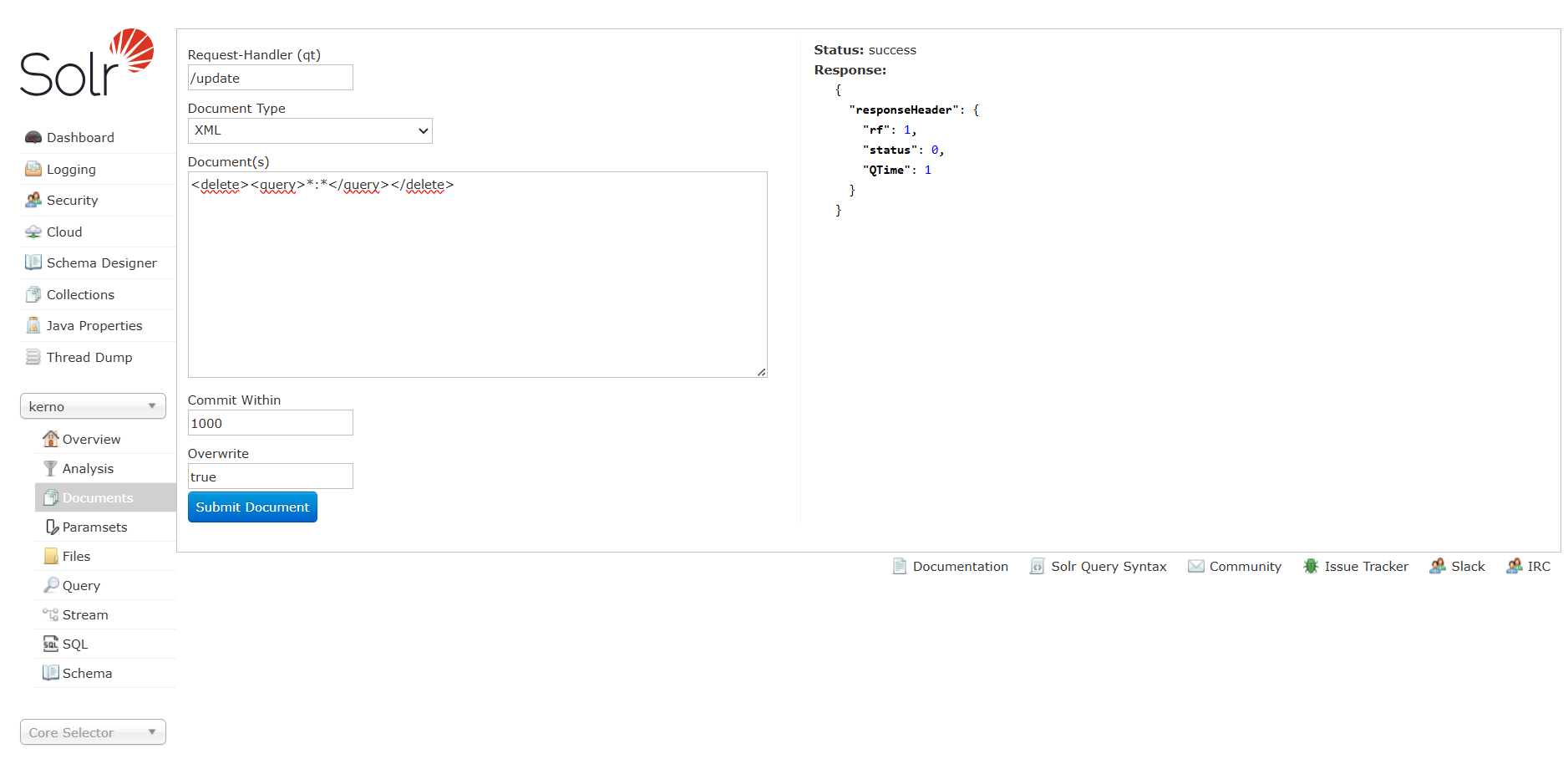
To clear the content of the Kerno collection, access the SOLR front end and run the following command:
<delete><query>*:*</query></delete>
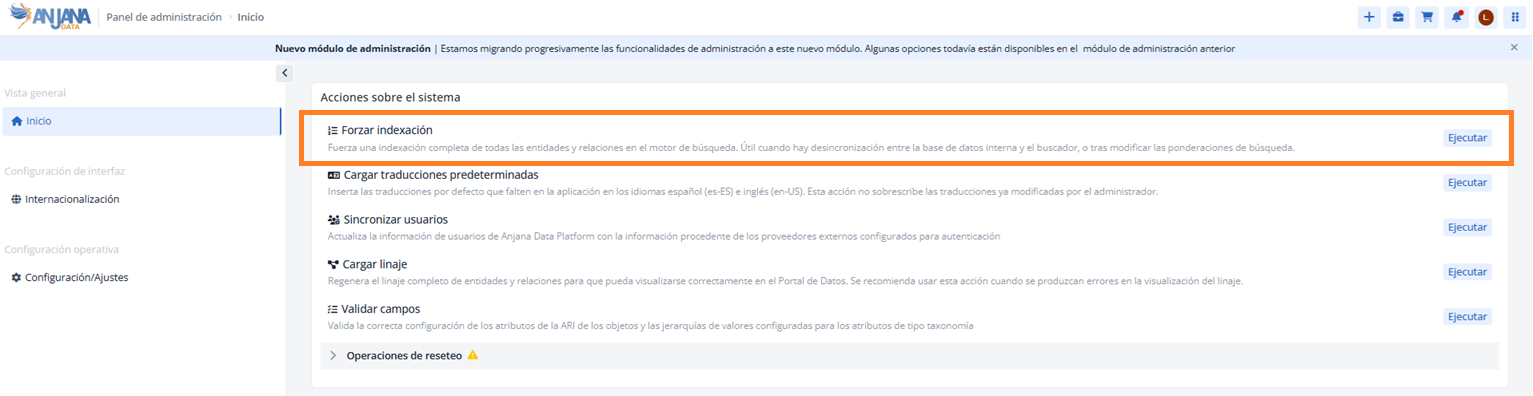
Next, access the new Anjana Data Platform Administration Portal and reindex (Home > System actions > Force indexing)
Removing the search engine configurations
To remove any search engine configuration, follow these steps:
-
Delete the Kerno collection with schema deletion through the API. See https://wiki.anjanadata.com/es/integraciones/25.2/api-doc
-
Restart the Minerva microservice to recreate the collections
systemctl restart minerva